Thursday, April 1, 2021

Viva Canonero!


Viva Canonero!
Latin American Hero

Joseph Di Rienzi


This year marks the 50th anniversary of the implausible Kentucky Derby victory of an erstwhile undistinguished horse who had previously raced in Venezuela. In the mold of a true “rags to riches” story, Canonero II for a brief five weeks shined across the U. S. thoroughbred racing landscape, until coming back to reality on a sultry Saturday in June at Belmont Park. In this piece, I will discuss the dizzying climb to the top of this true underdog and his ultimate fall.

Canonero II for all his Latin American roots was a product of European-U. S. breeding. His sire was English bred Pretendre who raced prominently in the UK, narrowly losing the country’s premier race -the Epsom Derby. Canonero II’s dam, Dixieland II, was sired by successful stallion Nantallah. The resulting foal of this union, a bay colt born in 1968 in Kentucky, was bred by Edward Benjamin. Having a misshaped foreleg led to the horse who would be named Canonero II (there was a predecessor with the same appellation) sold at auction as a yearling for a paltry $1200. He was bought by Pedro Baptista raced in the name of his son-in-law, Edgar Caibett, and was trained by Juan Arias.

Beginning his racing career in August 1970 as a two-year-old at La Rinconada Racetrack in Caracas, Venezuela, Canonero II won his initial start, drawing away by 6½ lengths. Making his first foray into the U. S., his connections sent him to California to race twice at Del Mar Racetrack in September where Canonero II finished third in an allowance race and then fifth in the Del Mar Futurity. Returning to Venezuela, he began what in retrospect was his Triple Crown campaign with a victory in December at La Rinconada, then raced steadily in the new year winning half of his first eight starts. Perhaps the most notable was a victory in March 1971 at the exact 1¼ mile distance of the Kentucky Derby.

Canonero II’s chances in the 1971 Derby were enhanced by the apparent lack of quality in his competition. The Two-Year-Old Champion of 1970, Hoist the Flag had made an auspicious beginning as a sophomore winning an allowance race at Bowie Racecourse and then decimating his field in the Bay Shore Stakes at Aqueduct Racetrack. However, in training for his next start in New York, the son of Tom Rolfe suffered a catastrophic injury that fortunately did not end his life, but terminated his racing career.

In the absence of a clear divisional leader, the top contenders appeared to be Jim French, a sturdy colt who under the training of John Campo raced literally coast-to-coast winning the Santa Anita Derby and placing in several of the year’s significant prep races. Also, there was Unconscious, who though defeated by Jim French in the Santa Anita Derby, had rebounded with an impressive victory in the California Derby at Golden Gate Fields. Calumet Farm had Eastern Fleet who, although inconsistent, had managed to defeat Jim French in the Florida Derby at Gulfstream Park.

All did not go smoothly for Canonero II in his immediate preparations for the Kentucky Derby. The airplane carrying him from Venezuela had to turn back twice due to mechanical issues. When the colt finally landed in Florida, he had to undergo a long van ride to Louisville, KY.  Upon arrival, he was required to stay in quarantine for four days. All this appeared to take a toll on Canonero II’s physical condition, and his lone timed workout over the Churchill Downs racing surface was slow by U. S. training standards.

The field for the 97th Kentucky Derby swelled to 20 entries with the prospects of a wide open race. The public settled on Unconscious as the favorite over the Calumet Farm entry of Eastern Fleet and Bold and Able with Jim French the third choice. Canonero II, who as a single betting entry would have been at astronomical odds, went off instead at a modest 9-1, in that he was part of the mutual field and coupled with five other horses (which finished 16th through 20th place).

Bold and Able, breaking from the inside post position, set the pace followed by Jr’s Arrowhead and Eastern Fleet. Canonero II, at one point was in 18th place but made a bold move outside of horses along the backstretch to reach contention around the final turn. Meanwhile, Jim French was weaving his way toward the front from mid-pack. Eastern Fleet slipped inside his stablemate to assume the lead at the head of the stretch, but he was no match for Canonero II’s sustained rally. At the finish it was the South American raced horse winning under regular rider Gustavo Avila by 3¼ lengths over Jim French with Bold Reason, third two lengths back. Eastern Fleet held on for fourth place, and Unconscious ran evenly to finish fifth.

The result was a shock that reverberated across the racing world. There were figurative fireworks in the winner’s circle as Canonero II’s connections celebrated their Venezuelan pride. (Fortunately there was a person serving as an interpreter in the post-race interviews, but despite some translation issues, the joy of the moment was evident for all).
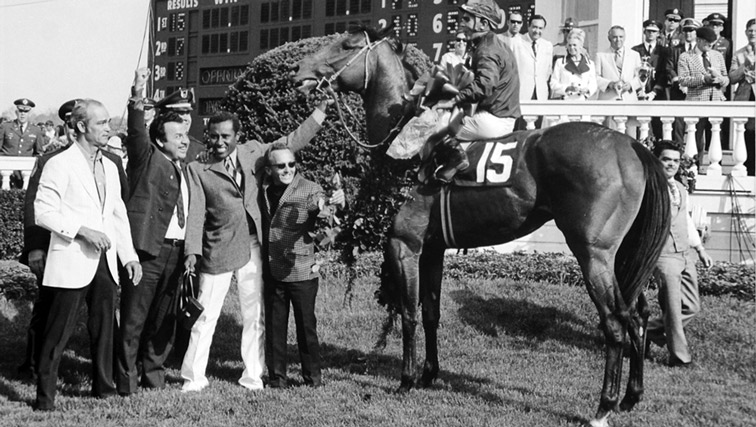
Canonero II in the 1971 Kentucky Derby winner's circle
(cms.equibase.com)


The elation exhibited by this horse’s victory extended into the two week interval between the Kentucky Derby and the Preakness Stakes. Suddenly he was a national hero and shouts of “Viva Canonero” were heard across Venezuela. (There was a vibrant party at the Venezuelan Embassy in Washington D. C. the night before the Preakness in honor of Canonero II, and the country’s Presidente sent a congratulatory message).

The Preakness field featured Canonero II, Jim French, Eastern Fleet, Bold Reason, Vegas Vic, and Impetuosity, all from the Derby, with the additions of Flamingo Stakes winner Executioner, and leading two-year-old of 1970 Limit to Reason who had finished second and third, respectively to Sound Off in the Preakness Prep. The question surrounding the second jewel in the Triple Crown was the Derby win by Canonero II a fluke? He did go to post the co-favorite with Jim French with Executioner the third betting choice. In a race that was the polar opposite of his Derby win, the Venezuelan raced horse pressed the pace set by Eastern Fleet as soon as the field turned down the backstretch. Setting fast fractions, the two runners ran 1-2 around the racetrack until deep stretch Canonero II when gradually pulled away to win by 1½ lengths in a track record performance. Eastern Fleet finished a game second 4½ lengths in front of the ever present Jim French. Bold Reason was fifth, Executioner sixth and Limit to Reason 11th and last. Amid the joy and celebrations from the Venezuelan contingent, in the winner’s circle the word “superhorse” was heard. Was there anything this horse could not do?

Canonero II winning the 1971 Preakness Stakes
(Blood-Horse photo)


Belmont Park on Belmont Stakes day was a fiesta of Latin American exuberance with a record crowd of 83,000 people. Bands were playing, people were singing and dancing all in anticipation of a new Triple Crown winner. Canonero II’s performances in the Derby and the Preakness had caught people’s imagination in the U. S., particularly the Latin American community. All he needed to do was to complete the triple by winning the Belmont to unleash all the longing for a new equine hero. Unfortunately, thoroughbred racing is full of disappointments, none greater than seeking to win the Belmont after dual classic triumphs. A sign that this was not a fait accompli were the 12 other entries challenging Canonero II. There were reports that not all was well with the Derby-Preakness winner. He had developed a skin infection and thrush in his right hind hoof, and he did not appear to be doing any serious training in preparation for the Belmont. However, he did go off the odds-on favorite with the John Campo trained entry of Jim French – Good Behaving the second choice.  A new horse to the Triple Crown races was October House Farm’s Pass Catcher. Conditioned by Eddie Yowell, the son of All Hands as a two-year-old had placed in several stakes. An injury suffered in the Hopeful Stakes ended Pass Catcher’s juvenile year. Slow to find his best form as a sophomore, Pass Catcher came into the Belmont Stakes off a strong second place finish in the Jersey Derby run at Garden State Park the Monday before the Belmont.

At the start, jockey Avila sent Canonero II straight to a clear lead and set a controlled pace with Bold Reason, Pass Catcher and longshot Twist the Axe tracking him. Twist the Axe moved first, getting within a ½ length of the leader. However, it was Pass Catcher under jockey Walter Blum who made a sudden move with ½ mile remaining to sweep pass Canonero II who had no response and established a lengthy lead in the stretch. Blum, however, lost his whip, and Jim French closing relentlessly cut the margin to ¾ length at the wire. Bold Reason repeated his Derby third, 2½ lengths behind Jim French with Canonero II, a game but tired fourth, a neck back.

Pass Catcher leading in the 1971 Belmont Stakes
(Blood-Horse photo)


The celebration in the winner’s circle was muted, only enjoyed by the connections of Pass Catcher – October House Farm owner Peter Kissel, trainer Eddie Yowell, jockey Walter Blum and the bettors who cashed in on the 35-1 odds. Many in the Latino community at Belmont that day went home disappointed not seeing their “compadre” perform at his best to win thoroughbred racing’s greatest goal. 

Canonero II was sold to the legendary King Ranch shortly after the Belmont for a price reportedly to be $1.5 million. Plagued by injuries, he would not return to the races until the following year, and when so, he would trained by Buddy Hirsch. His four-year-old campaign was not successful except for one shining moment. He began 1972 with a decent second place finish in the Carter Handicap at Belmont Park, then went on a five race losing streak. However, in September he found his best form winning the Stymie Handicap by 5 lengths from Riva Ridge, the year’s Kentucky Derby and Belmont Stakes winner, setting a new 9 furlong Belmont Park track record. (It must be noted that the younger Riva Ridge was conceding the older Canonero II a hefty 13 lb. in weight assignments.) In what would be Canonero II’s last race he finished second to Autobiography, who would be voted the year’s best older male horse in an allowance race at Belmont Park.  Entered for the Jockey Club Gold Cup, Canonero II was scratched due to an ankle injury and retired. oHohOhH

His stud career in the U. S. was desultory and eventually he was returned to Venezuela where Canonero II died of an apparent heart attack in 1981. But despite his quiet ending, the memories of his Kentucky Derby and Preakness victories still are etched across the thoroughbred landscape along with the resounding cry, “Viva Canonero!”

Tuesday, October 27, 2020

The Kentucky Derby - Breeders' Cup Classic Double, Part I


The Kentucky Derby – Breeders’ Cup Classic Double, Part I

Joseph Di Rienzi


In the 36 year history of the Breeders’ Cup World Championships, Kentucky Derby winners have several times participated in the Breeders’ Cup Classic, the climatic race of the whole Breeders’ Cup series. Contested at the same 1¼ mile distance as the Kentucky Derby, it is a fitting venue for the Derby hero to prove his/her worth against the best dirt campaigners of the year. In total, there have been fifteen Kentucky Derby winners to try the Classic with five returning victorious. In this two part series, I will reprise the Classic victory of those who completed the Kentucky Derby – Breeders’ Cup Classic double and give passing reference to those Derby winners who were not successful in the Classic. 

Though the Breeders’ Cup began in 1984, it was not until 1987 that a Kentucky Derby winner was entered in the Classic. In fact, in that year there were two Derby heroes – Ferdinand, the 1986 winner, and Alysheba the current year’s victor (and Preakness Stakes winner) who were among the twelve entered at Hollywood Park on November 21. Ferdinand appeared to have the advantage in the Breeders’ Cup Classic as the older competitor racing at a track where he won the Hollywood Gold Cup (at the same distance as the Classic). There was some support for the defending Breeders’ Cup Classic winner Skywalker and Canadian bred three-year-old Afleet. Other contenders were Cryptoclearance, Nostalgia’s Star, Gulch, Candi’s Gold and Judge Angelucci. The last named, trained by Charlie Whittingham (as was Ferdinand) had developed into more than just a pace setter for his barn mate. Since finishing second to Ferdinand in the Hollywood Gold Cup, the son of Honest Pleasure had won three of four stakes races.

The Classic was, to employ an overused expression, a thriller. Candi’s Gold and Judge Angelucci went for the lead and set a steady pace. Ferdinand began in mid-pack but raced into contention along the backstretch. Alysheba was initially placed far back and made a bold move on the outside as the field headed around the far turn. At the top of the stretch, Ferdinand, under Bill Shoemaker, cruised up alongside the battling leaders, Judge Angelucci and Candi’s Gold. Knowing his mount’s habit of pulling himself up once he gains the lead, Shoemaker was waiting to the last moment to urge Ferdinand forward. However, when he saw Alysheba coming resolutely to his right, Shoemaker called on Ferdinand, who surged forward to gain a clear advantage. In the shadow of the finish line, Alysheba closed dramatically to just miss winning by a nose. (An unforgettable memory is race caller Tom Durkin’s pronouncement that “the two Derby winners hit the wire together”.) In third place, 1¼ lengths behind, was a very game Judge Angelucci with Candi’s Gold another 1½ lengths back in fourth place. (Skywalker in his attempt to win the Classic again finished twelfth and last.)

Ferdinand winning the 1987 Breeders' Cup Classic
(bloodhorse.com)

As a result of this victory, Ferdinand, owned by Mrs. Howard B. Keck, despite having lost his first six races of the year, was voted the Eclipse Award both for Champion Older Male Horse and Horse of the Year. Alysheba, due to his overall record and powerful performance in the Breeders’ Cup Classic, was voted Champion Three-Year-Old Male.

Alysheba was given a second opportunity to the win the Breeders’ Cup Classic as a four-year-old in 1988. The sturdy son of Alydar, owned by Pamela and Dorothy Scharbauer and trained by veteran Jack Van Berg, was having another championship year racing all across the country. He had defeated Ferdinand twice at Santa Anita Park in the early part of 1988 and ventured east in the second half to win major races in New York and New Jersey.

Run on a cold miserable damp day in November at Churchill Downs, the nine horse Classic field contained all the top horses in training.  Alysheba, Waquoit, Cryptoclearance, Personal Flag, Cutlass Reality and Slew City Slew represented the four years and older division, whereas Forty Niner, Seeking the Gold and Lively One comprised the sophomore set. Alysheba’s overall record, plus the fact he was racing where he won last year’s Kentucky Derby made him the most probable winner. The doubters pointed to his recent narrow victories suggesting there was not much difference between him and his competitors. With the muddy conditions, there were memories of his floundering in the mud at Saratoga Racetrack in the previous year’s Travers Stakes. Nevertheless, Alysheba was the solid post time favorite. Waquoit, off a dominating Jockey Club Gold Cup win, was the second choice with Forty Niner the third betting favorite. The Phipps stable entry of Seeking the Gold and Personal Flag was the fourth choice.

Waquoit and Slew City Slew went head and head for the early lead; Cutlass Reality was third with Alysheba in fourth place. Forty Niner was just inside Alysheba down the backstretch. Alysheba launched his rally as the field approached the far turn. Forty Niner was moving with him when suddenly jockey Julie Krone lost control, and the Mr. Prospector colt dropped back to last place. (Krone reported post-race that she felt her mount had stumbled.) At the top of the stretch, several runners were in contention, but the strongest were Alysheba and Seeking the Gold who had rallied outside of everybody. For an instance, it looked that Seeking the Gold would gain the advantage, but Alysheba, resolute as always, held the younger rival’s surge at bay and finished a ½ length in front. Five lengths back in third was Waquoit with Forty Niner closing gamely from his setback along the turn, finished a neck back in fourth in a performance that should have had him closer. The impact of the race resulted in Eclipse Awards for Alysheba for both Older Male Horse and Horse of the Year.

Alysheba winning the 1988 Breeders' Cup Classic
(bloodhorse.com)


The following year Breeders’ Cup Day was held at Gulfstream Park, and the Classic featured the fourth meeting between those racing titans Easy Goer and Sunday Silence. The two three-year-olds had battled fiercely through the Triple Crown series with the latter gaining victories in the Kentucky Derby and Preakness Stakes, while the former was triumphant in the Belmont Stakes. There were six others in the field, however, just about everybody picked the two sophomores to finish first and second. Easy Goer was the surprising strong favorite, considering that Sunday Silence had won two of the three previous meetings. The result of the Belmont Stakes was taken as definitive in which Easy Goer won by 8 dominant lengths. However, that was at 1½ miles and around Belmont Park’s gentle turns. The Breeders’ Cup Classic was run at a 1¼ mile around the tight oval of Gulfstream Park which Easy Goer had not negotiated well in the past. An added uncertainty was that Chris McCarron was now the rider of Sunday Silence in that his regular jockey Pat Valenzuela was serving a suspension due to repeated drug abuse.

As the race began, Slew City Slew showed his speed to take a 3 length lead setting a fast pace with Blushing John in second. Sunday Silence was parked in fourth and then advanced to third, with Easy Goer further back in sixth place. Down the backstretch, Sunday Silence ambled smoothly toward the leaders, and Easy Goer made a quick move to be just behind his rival. Around the turn, Blushing John forged to the front as Slew City Slew fell back. As feared, Easy Goer was not able to keep pace around the final turn with Sunday Silence and lost ground. At the top of the stretch, Sunday Silence readily moved to and then past Blushing John as Easy Goer mounted a desperate challenge once in the straight. In the last 1/16 of a mile, Easy Goer closed considerable ground but fell short by a neck at the finish. Blushing John in a strong effort was 1 length behind Easy Goer but almost 10 lengths in front of fourth finishing Present Value.


For the partnership of Dr. Ernest Gaillard, Arthur Hancock III and Charlie Whittingham that owned Sunday Silence, this victory was the year’s culmination. For Whittingham this was his second Kentucky Derby - Breeders’ Cup Classic double trained winner after Ferdinand in 1987.  Naturally, Three-Year-Old Male Champion and Horse of the Year honors were awarded to Sunday Silence although there are still some stubborn observers (myself included) who believe Easy Goer was the better horse.


(To be continued in part II.)

Tuesday, October 13, 2020

The Most Dramatic Breeders' Cup Classics, Part II


The Most Dramatic Breeders’ Cup Classics, Part II

Joseph Di Rienzi


This is the second of a two part series on what I consider are the five most dramatic Breeders’ Cup Classic races. In part I, I discussed my fifth (in 1998), fourth (1987) and third ranked (2016) editions of this annual contest. Here I will review the two most dramatic renewals.


Number 2: 1989

The pièce de résistance of the Breeders’ Cup Day held this year at Gulfstream Park was the Classic, and it featured the fourth meeting between those racing titans Easy Goer and Sunday Silence. The two three-year-olds had battled fiercely through the Triple Crown series with the latter gaining victories in the Kentucky Derby and Preakness Stakes, while the former was triumphant in the Belmont Stakes. There were six others in the field, however, just about everybody picked the two sophomores to finish first and second. Easy Goer was the surprising strong favorite, considering that Sunday Silence had won two of the three previous meetings. The result of the Belmont Stakes was taken as definitive in which Easy Goer won by 8 dominant lengths. However, that was at 1½ miles and around Belmont Park’s gentle turns. The Breeders’ Cup Classic was run at a 1¼ mile around the tight turns at Gulfstream Park which Easy Goer had not negotiated well in the past. An added uncertainty was that Chris McCarron was now the rider of Sunday Silence in that his regular jockey Pat Valenzuela was serving a suspension due to repeated drug abuse.

As the race began, Slew City Slew showed his speed to take a 3 length lead setting a fast pace with Blushing John in second. Sunday Silence was parked in fourth and then third, with Easy Goer further back in sixth place. Down the backstretch, Sunday Silence ambled smoothly toward the leaders, and Easy Goer made a quick move to be just behind his rival. Around the turn, Blushing John forged to the front as Slew City Slew fell back. As feared, Easy Goer was not able to keep pace around the final turn with Sunday Silence and lost ground. At the top of the stretch, Sunday Silence readily moved to and then past Blushing John as Easy Goer mounted a desperate challenge once in the straight. In the last 1/16 of a mile, Easy Goer closed considerable ground but fell short by a neck at the finish. Blushing John in a strong effort was 1 length behind Easy Goer but almost 10 lengths in front of fourth finishing Present Value.                         


For the partnership of Dr. Ernest Gaillard, Arthur Hancock III and Charlie Whittingham that owned Sunday Silence, this victory was the year’s culmination. For Whittingham this was his second Breeders’ Cup Classic trained winner after Ferdinand in 1987.  Naturally, Three-Year-Old Male Champion and Horse of the Year honors were awarded to Sunday Silence although there are still some stubborn observers (myself included) who believe Easy Goer was the better horse.


Number 2: 2010

The 27th edition of the Breeders’ Cup Classic held this year at Churchill Downs was all about Zenyatta. The remarkable six-year-old mare was undefeated in 19 starts stretching over four racing years. The Ann and Jerry Moss owned and John Sheriffs trained daughter of Street Cry had scored an incredible victory in the previous year’s Classic at Santa Anita (on a synthetic dirt surface) and was trying to be only the second two time winner. (Tiznow accomplished the feat in 2000 and 2001.)

As darkness rolled in on November 6, the stage was set for an epic Breeders’ Cup Classic. Despite being the defending champion, there were many who doubted Zenyatta would be able to repeat. They cited that this Classic was on conventional dirt (ignoring the fact she had won the Apple Blossom Handicap twice over Oaklawn Park’s dirt surface). They also questioned the quality of the females she had been defeating all year, while in the Classic she would be facing top male horses such as Blame, Quality Road,  Lookin At Lucky and Haynesfield. (The critics seemed to forget that Zenyatta defeated a top class international group of horses in last year’s Classic.) Finally, they noted that her speed figures were not as high as her Classic rivals’ numbers, again not realizing that a come from behind horse such as Zenyatta was only racing fast enough to catch the front runners.

The betting public, ignoring these negatives, installed Zenyatta the even money favorite with sophomore Lookin At Lucky the narrow second choice over Blame, considered the top older male entry. In a race that will be remembered forever in Breeders’ Cup history, Zenyatta broke slowly in the twelve horse field and found herself last, several lengths behind the eleventh place horse. Down the backstretch, First Dude set the pace with Quality Road, Japanese raced Espoir City and Haynesfield tracking. In the next group some 4 lengths behind was Looking At Lucky with Blame alongside saving ground under Garrett Gomez, while Zenyatta was still, seemingly languishing, in last place. Around the far turn the field started bunching up as Quality Road dropped back suddenly and Lookin At Lucky and Blame launched their bid side by side between horses. Meanwhile, Mike Smith took Zenyatta first to the inside around the far turn and then swung her wide for clear running room. In mid-stretch, Blame was pulling clear from Lookin At Lucky with Zenyatta looming on the outside some lengths away. At first, it looked impossible she would be able to run Blame down, then it seemed likely, but in the end, Blame was able to hold off Zenyatta’s charge by a desperate head. Fly Down closed ground to be third, 3½ lengths back with Lookin At Lucky a neck back in fourth, while Quality Road retreated to last place.

Blame defeats Zenyatta (no. 8) in the 2010 Breeders' Cup Classic
(nytimes.com)

Those in attendance were numb from the dramatic finish, thrilled and sad at the same time. Claiborne Farm’s President Seth Hancock, co-owner of Blame, was quoted as saying, “I’m proud to win the race, but I take no pride in beating Zenyatta. She is awesome, and she’s been great for racing.” Blame deserved the win, but Zenyatta was magnificent in defeat. The day after the Classic, hundreds of fans came to the fence as Zenyatta grazed outside her Churchill Downs barn to pay tribute and present gifts to this magnificent animal even more revered in defeat than in victory. For Blame’s connections (Claiborne Farm and Adele B. Dilschneider), this was a triumph to celebrate, and his victory marked a return to glory for the historic farm. Trainer Al Stall Jr. was rewarded for his patience with bringing Blame up to this peak performance, and for Garrett Gomez, whose personal life would take a downward spiral, this win was a racing pinnacle.

For the Eclipse Awards, Blame was the Champion Older Male Horse and Zenyatta the corresponding Female. In a contentious voting, Zenyatta outpolled Blame for Horse of the Year. She was retired with a record of 19 wins and 1 second in 20 starts in addition to a legacy as one of the greatest horses this country has ever seen. 

This year’s Breeders’ Cup Classic will be held at Keeneland Racecourse on November 7th. As I have tried to show in this series, the Classic has produced some of the thoroughbred sports’ most indelible memories. I can only hope the 2020 edition will continue that tradition.

Thursday, October 8, 2020

The Most Dramatic Breeders' Cup Classics


The Most Dramatic Breeders’ Cup Classics, Part I

Joseph Di Rienzi


The pinnacle of the annual Breeders’ Cup Championship series is usually the 1¼ mile Breeders’ Cup Classic – the final race of the now two day meet. Over its 36 year history, the Classic has been won by some of the thoroughbred sports’ equine stars. Names such as Cigar, Skip Away, Curlin, Zenyatta and American Pharoah [sic] have etched their names in the honor’s list of Classic victors. In this two part piece, I will discuss what I consider the five most exciting editions (in reverse order) taking into consideration the quality of the field and the closeness of the finish.

Number 5: 1998

This could very well have been the deepest field in quality in the Breeders’ Cup Classic history. Held this year at Churchill Downs, the headliners among the 10 horses entered in the Classic were two grays - Skip Away (double champion and 1997 Classic winner) and Silver Charm (1997 Kentucky Derby and Preakness Stakes hero and this year’s Dubai World Cup victor) both vying for Older Male and Horse of the Year honors. The rest of the field included the Frank Stronach owned pair - Awesome Again and Touch Gold as well as Victory Gallop (the Belmont Stakes hero), Coronado’s Quest (Travers Stakes winner), Gentlemen, Arch, Running Stag and Swain. The last named was mainly European raced but could not be dismissed based on his close finish to Silver Charm in the Dubai World Cup. Skip Away was the favorite, but there was some concern over his soundness, his relatively recent poor performance in the Jockey Club Gold Cup (a badly beaten third place finish), and the fact he had run the worst race of his career at Churchill Downs in the 1996 Kentucky Derby. Good chances were given to Silver Charm, the Stronach entry and Swain.

As the field broke from the gate, Coronado’s Quest forged to the front over Arch with Skip Away and Silver Charm side by side in third and fourth position. Swain and Gentlemen were not far back in fifth and sixth place, respectively. Down the backstretch, Coronado’s Quest continued to lead with the others close behind. Skip Away made a move along the inside but was repelled as Silver Charm came up the outside. At the top of the stretch, Coronado’s Quest was still in front but strongly challenged by Silver Charm. Swain made his move along the outside but, in doing so, drifted far right under jockey Frankie Dettori’s urging. It looked like a three horse finish among Coronado’s Quest, Silver Charm and Swain who were spread out across the racetrack when suddenly Awesome Again and then Victory Gallop charged between a large gap. At the finish, Awesome Again was ¾ of a length in front of Silver Charm who had a neck advantage over Swain. The European, in a massive effort, held third by a nose over Victory Gallop who was 1 length in front of Coronado’s Quest. Skip Away, who was not the same racehorse as had been seen the past three years, finished sixth in his final start, beaten a total of four lengths.


Awesome Again (in center) 
winning the 1998 Breeders’ Cup Classic
(bloodhorse.com)

This was a great victory for the owner-trainer team of Frank Stronach and Pat Byrne, respectively. Although, Awesome Again was undefeated in six 1998 starts, his Breeders’ Cup Classic victory was not sufficient to persuade enough voters to award him championship honors. The Eclipse Award for Older Male went to Skip Away despite defeats in his last two races. Skip Away was also voted Horse of the Year, for his overall 1998 record, and the fact he probably should have won that Eclipse Award in 1997.  


Number 4: 1987

At Hollywood Park, a field of 12 entered the starting gate for the fourth Breeders’ Cup Classic headed by two Kentucky Derby winners - Ferdinand (the 1986 victor) and Alysheba (this year’s Derby hero). Ferdinand appeared to have the upper hand as the older competitor racing at a track where he won the Hollywood Gold Cup (at the same 1¼ mile distance as the Classic) and bringing a series of sparkling workouts leading up to the race. There was some support for the defending Breeders’ Cup Classic winner Skywalker and Canadian bred three-year-old Afleet. Other contenders were Cryptoclearance, Nostalgia’s Star, Gulch, Candi’s Gold and Judge Angelucci. The last named trained by Charlie Whittingham (as was Ferdinand) had developed into more than just a pace setter for his barn mate. Since his second to Ferdinand in the Hollywood Gold Cup, the son of Honest Pleasure had won three of four stakes races.

The Classic was, to employ an overused expression, a thriller. Candi’s Gold and Judge Angelucci went for the lead and set a steady pace. Ferdinand began in mid-pack but raced into contention along the backstretch. Alysheba was initially placed far back and made a bold move on the outside as the field headed around the far turn. At the top of the stretch, Ferdinand, under Bill Shoemaker, cruised up alongside the battling leaders, Judge Angelucci and Candi’s Gold. Knowing his mount’s habit of pulling himself up once he gains the lead, Shoemaker was waiting to the last moment to urge Ferdinand forward. However, when he saw Alysheba coming resolutely to his right, Shoemaker called on Ferdinand who surged forward to gain a clear advantage. In the shadow of the finish line, Alysheba closed dramatically to just miss winning by a nose. (An unforgettable memory is race caller Tom Durkin’s pronouncement that “the two Derby winners hit the wire together”.) In third place, 1¼ lengths behind, was a very game Judge Angelucci with Candi’s Gold another 1½ lengths back in fourth place. (Skywalker in his attempt to win the Classic again finished twelfth and last.)


Ferdinand winning the 1987 Breeders’ Cup Classic
(bloodhorse.com)

As a result of this victory, Ferdinand, owned by Mrs. Howard B. Keck, despite having lost his first six races of the year, was voted the Eclipse Award both for Champion Older Male Horse and Horse of the Year. Alysheba, due to his overall record and powerful performance in the Breeders’ Cup Classic, was awarded Champion Three-Year-Old Male.


Number 3: 2016

The Breeders’ Cup Classic, the climatic race of the two day Breeders’ Cup series, held this year at Santa Anita Park on November 5, had a nine horse field. Now a five-year-old, California Chrome, at the time North America’s  leading money earner, was attempting to complete a perfect season that the 2013 double classic winner and former Horse of the Year began in January at Santa Anita. His main adversary appeared to be Juddmonte Farms’ sophomore Arrogate who burst onto the national racing scene with a sensational Travers Stakes victory. Other entries included Frosted, Melatonin, Hoppertunity, Effinex and Keen Ice. At post time, California Chrome was the 9-10 favorite, but Arrogate at 8-5, was installed the strong second choice.

After the break, Victor Espinoza sent “Chrome” to the front followed by Melatonin. Arrogate, breaking from the no. 9 post, was not sent forward by Mike Smith as he did in the Travers but took a rating position in third place a couple of lengths behind the leader. The first three positions were unchanged down the backstretch as California Chrome was running comfortably on the lead. Around the far turn, Smith angled Arrogate inside of Melatonin as he took aim at California Chrome. Down the stretch, California Chrome continued to stride out purposefully, and, although Arrogate was under a drive on the outside, it appeared he was not gaining. That changed just before the finish when the big son of Unbridled’s Song leveled out as only the really good horses do and thrusted himself forward to pass Chrome for an astonishing ½ length victory. The magnitude of the performance of the top two finishers was exemplified in that third finishing Keen Ice checked in 10¾ lengths further back. Hoppertunity was fourth; Melatonin finished fifth; Frosted was sixth, and Effinex checked in at seventh place.


Arrogate wins the 2016 Breeders’ Cup Classic
(nytimes.com)

Arrogate became the third consecutive Classic winner conditioned by Bob Baffert. For Juddmonte Farms, who has had so many top class runners in Europe and turf champions in the U. S., this victory ranks up with their Empire Maker’s 2003 Belmont Stakes victory. This was Mike Smith’s fourth Classic winning mount with Skip Away (in 1997), Drosselmeyer (in 2009) and Zenyatta (2011) the other three. At year’s end, Arrogate was voted the Eclipse Champion Three-Year-Old Male, California Chrome the Older Dirt Male Champion and Horse of the Year (despite losing the Classic), easily outpolling Arrogate.


(To be continued in part II.)

Friday, September 18, 2020

Wilted Roses But Blooming Susans


Wilted Roses But Blooming Susans

Joseph Di Rienzi


For most of its history, the Preakness Stakes has been contested subsequent to the Kentucky Derby. Even in this tumultuous year, the 145th renewal will be contested four weeks (instead of the typical two) after the Derby. Most logics would conclude that a good performance in the Kentucky Derby would be a key to winning the Preakness Stakes. However, history can demonstrate that an out of the money performance (worse than third place) in the Derby does not preclude a Preakness victory. Indeed, in the last decade (2010 – 2019), four horses that finished out of the top three on the first Saturday in May carried a blanket of black-eyed Susans (actually dyed daisies) in the Pimlico Racetrack’s winner’s circle. Here I will look briefly at each of these horses’ turn in fortune from the first to the second jewel in the Triple Crown.

Lookin At Lucky advanced toward the 2010 classics with sterling credentials. He was voted the 2009 Eclipse Award for Champion Two-Year-Old Male despite a tough luck loss in the Breeders’ Cup Juvenile. Owned by Karl Watson, Mike Pegram and Paul Weitman and trained by Bob Baffert, the handsome son of Smart Strike had two prep races prior to the Kentucky Derby. He scored a narrow victory in the Rebel Stakes at Oaklawn Park in Arkansas and then was a troubled third in the Santa Anita Derby.

Favored for the Kentucky Derby despite drawing the dreaded no. 1 post position, Lookin At Lucky ran to Bob Baffert’s worst fears by being crowded right after the start. Then he was impeded shortly after, forcing his jockey Garrett Gomez to take him near the rear of the field. Lookin At Lucky was able to close some ground in the stretch, but the best he could finish was sixth beaten a total of 7 lengths to Derby winning Super Saver.

Two weeks later in Baltimore, the Preakness Stakes had Super Saver, Lookin At Lucky, and other Derby participants Paddy O’Prado, Dublin and Jackson Bend in the 12 horse field. Bob Baffert replaced top flight rider Garrett Gomez with young Martin Garcia, believing Gomez and Lookin At Lucky were not a good team. At post time, favoritism went to Super Saver over Lookin At Lucky.

The Preakness was an exciting race with First Dude setting a rapid pace followed by Super Saver. Lookin At Lucky was in mid-pack, but in the clear and, for a change, out of trouble. Around the far turn, Caracortado, Lookin At Lucky and Jackson Bend all went up to challenge First Dude as Super Saver could not keep pace. At the top of the stretch, the outcome was very much in doubt, but Lookin At Lucky showing his championship class prevailed by a ½ length over a tenacious First Dude, who in turn was a head in front of Jackson Bend for the place award. Super Saver faded in the stretch to finish eighth.


Lookin At Lucky winning the 2010 Preakness Stakes
(nytimes.com)

This was Bob Baffert’s fifth Preakness victory (he now has two more) and the second for part-owner Mike Pegram having won it with Real Quiet in 1998. This victory was especially sweet for Lookin At Lucky’s connections in that they had come to believe that, notwithstanding his name, the son of Smart Strike had been the victim of repeated bad fortune in such races as the Breeder’s Cup Juvenile, Santa Anita Derby and Kentucky Derby.

After his Preakness victory, Lookin At Lucky bypassed the Belmont Stakes but in the summer won the Haskell Invitational Stakes at Monmouth Park. Despite ending his racing career with a fourth place finish in the Breeders’ Cup Classic, Lookin At Lucky was voted the 2010 Eclipse Champion Three-Year-Old Male. He has become a fairly successful stallion since standing at Ashford Farm in Versailles, KY.

Unlike Lookin At Lucky, Shackleford’s rise to Preakness glory was, by in large, unanticipated. Bred and owned by Michael Lauffer and William Cubbedge, the bright chestnut with a broad blaze down his face was trained throughout his racing career by enterprising Dale Romans. Pretty much unknown until he nearly won the Florida Derby (at odds of 68-1) losing by a head to Dialed In, the son of Forestry came into the 2011 Kentucky Derby with just two wins in five starts. Sent off at 23-1 odds, Shackleford gave his backers a thrill as he led the field from the start to the last furlong when he was overtaken by Animal Kingdom, Nehro and Mucho Macho Man. Finishing fourth, he was beaten a total of only 4 lengths.

Two weeks later a full field of fourteen were loaded into the gate for the 136th Preakness Stakes. Off his Kentucky Derby victory, Animal Kingdom was the solid favorite. Bettors made Dialed In (the Kentucky Derby favorite) the second choice, giving him another chance off his subpar Derby effort in which he finished eighth. Mucho Macho Man was third in the wagering with Shackleford a generous 12-1 chance.

Over a fast but laboring Pimlico surface, Shackleford, under regular jockey Jesus Castanon, sat second forcing a fast early pace just behind speedy Flashpoint. Animal Kingdom broke slowly and was taken back to 13th with only Dialed In behind him. Flashpoint and Shackleford were first and second until midway around the far turn when the latter asserted himself establishing a clear lead. Astrology made a menacing move along the rail to challenge at the top of the stretch which Shackleford repelled. Animal Kingdom began his rally around the far turn swinging wide. The Derby winner was rolling, but he had a lot of ground to make up. As Animal Kingdom closed in, Shackleford grimly held the lead despite drifting first left and then right. At the finish, Shackleford was ½ length ahead of a dirt encrusted Animal Kingdom who was 1¼ lengths in front of Astrology. Dialed In’s belated rally gained him fourth place.


Shackleford winning the 2011 Preakness Stakes
(nytimes.com)

The Preakness winner’s circle contained an inordinate number of Kentuckians as owners Michael Lauffer and William Cubbedge, and trainer Dale Romans hailed from the Commonwealth. Indeed, Romans, a Louisville native, was instrumental in directing fellow trainer Graham Motion to the Churchill Downs’ winner’s circle after Animal Kingdom’s Kentucky Derby victory. Romans’ previous biggest triumph was his trainee Roses in May’s Dubai World Cup victory in 2005, but for jockey Jesus Castanon, this was his first winning ride on a national stage.

Shackleford, a robust individual, would be a fixture in major races for the next two years. He would finish fifth in the Belmont Stakes, but as a four-year-old, he would win such traditional fixtures as the Metropolitan and Clark Handicaps. Originally retired to stud at the end of 2012 to Darby Dan Farm in Kentucky, Shackleford was sent to South Korea in 2020.

In 2011 Brad Kelley had purchased a racy looking yearling son of Awesome Again that he named Oxbow. Turned over to Triple Crown icon D. Wayne Lukas to train, Oxbow had a modest juvenile season in 2012 winning just a maiden race in five starts. He began 2013 with an 11½ length victory in the LeComte Stakes at the Fair Grounds. Finishing a close fourth in his next start, the Risen Star Stakes, Oxbow then ran in the Rebel Stakes at Oaklawn Park and was beaten a head by another Lukas trainee Will Take Charge. Oxbow than completed his Kentucky Derby preparation with a fifth place finish in the Arkansas Derby. In this race, he was ridden by Gary Stevens who was in the midst of a comeback having retired eight years earlier.

Sent off at odds 24-1 in the Kentucky Derby, Oxbow ran a creditable race in challenging for the lead around the far turn only to tire in the stretch. He finished sixth to victorious Orb, beaten a little less than 10 lengths. In the Preakness, Orb ruled the strong favorite with the horses who finished second through fourth in the Kentucky Derby absent, but returning to contest the middle jewel were the Wayne Lukas pair – Oxbow (sent off at odds 15-1) and Will Take Charge, as well as Mylute, Itsmyluckyday and Goldencents.

Gary Stevens sensing a speed favoring Pimlico surface coaxed Oxbow to the lead. Goldencents, the expected pacesetter was taken back, and Oxbow was allowed to set uncontested moderate fractions. Orb, who broke from the rail, was closer than usual down the backstretch but lost position when horses came to his outside. Shuffled back on the far turn, he failed to mount a serious threat. In the stretch, Oxbow, maintained a clear lead as challenges came from Itsmyluckyday and Mylute. At the finish, Oxbow was 1¾ lengths in front with Itsmyluckyday besting Mylute for second by a ½ length. Orb finished fourth another 6¾ lengths behind.


Oxbow winning the 2013 Preakness Stakes
(foxnews.com)

The winning owner, Brad Kelley, had bought the property in which the legendary Calumet Farm once stood in 2012. His silks (black and gold) are different from the famed devil’s red and blue that were carried by so many of the sport’s fabled runners. Wayne Lukas, 77 years-old at the time, was celebrating his sixth Preakness victory and 50 year-old Gary Stevens his third. 

Three weeks later, Oxbow finished second (beaten 3¼ lengths) to Palace Malice with Orb third in the Belmont Stakes. At this point, on the basis of the Triple Crown races, it could be argued that Oxbow was the most consistent horse in his sophomore class. Unfortunately, the son of Awesome Again only ran once more (in the Haskell Invitational Stakes) finishing fourth. Suffering an ankle injury in the race, Oxbow was retired later in the year and currently stands stud at Calumet Farm in Lexington, KY.

War of Will is a striking dark bay son of War Front with a blaze and four white stocking feet from a mare by European super stallion Sadler’s Wells. Purchased in France as a juvenile in 2018 by an agent acting for trainer Mark Casse who in turn offered the horse to major client Gary Barber. With War Front as a sire and a strong European female line, War Front began his racing career in 2018 on the turf. Winless in his first four outings, he nonetheless finished second in the Summer Stakes and fifth in the Breeders’ Cup Juvenile Turf. War of Will concluded his juvenile campaign breaking his maiden on a sloppy Churchill Downs dirt surface in November. 

Starting 2019 at the Fair Grounds, War of Will stylishly won both the LeComte and Risen Star Stakes. Favored at odds-on to continue his domination of the three-year-old races in New Orleans, he lost his action right after the start of the Louisiana Derby and finished ninth. Despite this setback, Mark Casse was optimistic War of Will would be fit to race in the Kentucky Derby.

The 2019 Derby will be remembered long in Kentucky Derby folklore. (See “Recent Longshot Winners of the Kentucky Derby”.)  In short, as jockey Tyler Gaffalione guided War of Will off the rail to the outside of leader Maximum Security around the final turn, the latter did not corner the turn well, forcing the former wide. After losing his balance, War of Will faded in the stretch to finish in eighth place. At the finish, Maximum Security was 1¾ lengths in front of Country House who was ¾ of a length ahead of Code of Honor. After a jockey’s inquiry, the Churchill Downs’ stewards disqualified Maximum Security placing him 17th and declared Country House the Derby winner.

In the aftermath of the Kentucky Derby, Country House never raced again after a series of ailments and injuries, and the connections of Maximum Security were so upset over his disqualification they ruled him out of the other classics, seemingly from spite.

Of the Derby contestants, Improbable who finished officially fourth, Everfast (fifth), War of Will (seventh), Win (ninth) and Bodexpress (13th) forged on to contest the Preakness Stakes. They were joined by eight others in a less than stellar edition of this classic. The betting public installed Improbable as the favorite. War of Will, “a victim” of Maximum Security’s Derby misdeeds, was sent off at 6-1 odds.

At the start, Bodexpress reared up unseating John Velazquez and ran as a loose horse the entire race. Warrior’s Charge assumed the early lead followed by Market King and Anothertwistafate. War of Will, breaking from the no. 1 post (same as he did in the Derby), was placed by Tyler Gaffalione on the inside right behind the leading trio. With almost the identical trip he had in the Kentucky Derby at this point around the far turn, Gaffalione waited until the top of the stretch when this time he guided his mount through the inside to challenge. Gaining the advantage, War of Will forged to the front and held off the late closers. At the finish, he was 1¼ lengths in front of Everfast who held second by a nose over Owendale. Improbable, after being fractious before the break, raced in mid-pack without offering a consequential rally and finished sixth.


War of Will winning the 2019 Preakness Stakes
(nytimes.com)

In the winner’s circle, there was a feeling of vindication from the connections of War of Will. Prior to the Preakness, owner Gary Barber and trainer Mark Casse had traded verbal barbs with Gary West, co-owner of Maximum Security, in terms of the interference they believed compromised their horse’s chances in the Derby. This victory by the son of War Front, justified in their minds the disqualification. At age 24, Tyler Gaffalione, celebrated his first classic victory with the expectations this would not be his last.

After his Preakness triumph, War of Will went on a losing streak that included a ninth place finish in the Belmont Stakes. He returned to the winner’s circle with a narrow win in this year’s Makers’ Mile Stakes at Keeneland Racecourse. With this victory on the turf, War of Will becomes one of those rare performers who have scored major victories on both conventional dirt and grass. He continues to race in 2020 but will take up stud duties at Claiborne Farm in Versailles, KY in 2021.

So we see that it is possible to rebound from Kentucky Derby disappointment to Preakness glory. When this year’s Preakness is renewed on October 3, it may be prudent to pay attention to those who failed to make it in the top three on Derby Day. One of them just might garner the black-eyed Susans.